
 623-229-0463

Estate planning serves many purposes, including identifying tax-efficient strategies that preserve your assets during your lifetime and pass on as much wealth as possible to future generations. Even though Arizona has no estate tax or inheritance tax, other federal tax laws could apply and reduce the amount available to beneficiaries after you die. A knowledgeable attorney for tax and estate planning can help you avoid the common oversights and mistakes that might saddle your family with a larger-than-necessary tax bill after you’re gone.
The Importance of Tax-Aware Estate Planning
Tax planning should be a core component of estate planning. Many types of taxes can affect your taxable estate and the ultimate amount of wealth you leave behind, depending on the size of your estate and where you reside. Examples include:
- Federal estate taxes
- State estate tax and gift taxes (not applicable in Arizona)
- Capital gains taxes on residential and commercial property
- Income taxes on retirement accounts such as IRAs and 401(k)s
- Taxes on trusts
Various tax planning strategies can minimize your tax burden and preserve assets for your designated beneficiaries. An experienced tax and estate planning attorney can suggest tools that could be helpful based on your financial circumstances and long-term goals.
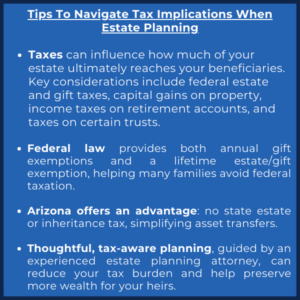 Federal Estate Tax vs. Federal Gift Tax
Federal law imposes taxes on the transfer of property through lifetime gifts or through estate administration. The federal government imposes a progressive estate and gift tax regime, with rates ranging from 18 to 40 percent.
However, tax laws provide exemptions that allow most lifetime gifts and estates to avoid federal taxes. First, individuals have an annual gift tax exemption that allows them to give gifts up to a specific total value tax-free. The exemption applies to each recipient of gifts, not to the total gifts given by an individual in a tax year.
Federal tax law also provides a lifetime estate and gift tax exemption that people can use to exempt all or a portion of their estate from taxation. These exemptions are adjusted annually for inflation, meaning that most estates avoid federal taxation.
Advantages in Arizona: No State Estate or Inheritance Taxes
In some states, tax laws require heirs and beneficiaries to pay inheritance taxes. However, Arizona has no estate or inheritance tax. That simplifies estate planning, allowing residents to transfer assets with no state tax consequences.
Key Strategies & Tools for Protecting Your Assets
Several estate planning tools can help individuals and families protect assets from taxation. Some of the most popular methods include:
- Trusts: Certain types of trusts legally remove assets from an individual’s estate, meaning those assets do not count when calculating federal estate tax liability for the individual’s estate after their death. Trusts can also utilize beneficiary designations to provide family members with inheritances or a legacy of lifetime financial support through periodic distributions.
- Gifting strategies: Annual and lifetime gift tax exclusions enable individuals to pass wealth to loved ones through regular tax-free gifts, providing family members with inheritances while also reducing an individual’s estate to minimize or avoid estate taxes.
- Charitable giving: Incorporating donations to charitable organizations through an estate plan can establish a philanthropic legacy and provide tax benefits to one’s family. Estate planning tools, such as charitable trusts, utilize charitable tax deductions while also protecting assets.
- Life insurance: When a person anticipates that their estate will incur tax liability, they might obtain life insurance. The death benefit can provide their estate and family members with the liquidity necessary to cover tax bills, allowing the family to keep real estate or other property rather than selling assets to raise money to pay estate taxes. They could also reduce their estate by placing assets into an irrevocable life insurance trust (ILIT).
Building a Resilient Plan with a Tax and Estate Planning Attorney
 If you have questions about estate planning and taxes, consulting with a trusted lawyer is a wise way to get answers. Pennington Law, PLLC is a respected Arizona estate planning law firm. Some of our attorneys are registered financial planners as well as lawyers, giving us a broad perspective that we leverage to work in our clients’ best interests. Contact us today for a confidential free consultation.
Frequently Asked Questions About Arizona Estate & Tax Planning
Below, you’ll find the answers to some of our most frequently asked questions about taxes and estate planning in Arizona.
How much can I give away each year without paying taxes?
Individuals have an annual gift tax exclusion that applies to each recipient rather than the total amount of gifts given in a year. People may also make gifts using their lifetime estate and gift tax exemption, which is adjusted periodically for inflation.
Will my children have to pay taxes on the house I leave them?
Your children may owe taxes when inheriting or selling the property you leave them. First, passing property to your children through your estate may trigger federal estate taxes if the value of your estate exceeds your federal lifetime estate and gift tax exemption. In addition, federal tax rules provide individuals who inherit real estate with a “stepped-up” basis in the property, meaning they inherit the property at its fair market value as of the date of the original owner’s death. Thus, any capital gains tax your children may owe from selling your house will depend on the value of the property on the date of your death, not the price you paid to purchase the property.
Is a will enough to avoid taxes?
A will might not help your family avoid all taxes on your property. Depending on the value of your estate, your loved ones may owe federal estate taxes. Furthermore, if you own property in certain states, your family members may owe inheritance taxes on those assets depending on that state’s laws. However, other estate planning tools, such as irrevocable trusts, can help you limit or avoid this tax liability.